What Is I-9 Employment Verification and How Does It Work?
Quick answer
Form I-9 is the federal form every U.S. employer must complete for each new hire to verify identity and authorization to work. The employee fills out Section 1; an employer or their authorized representative must physically examine the employee's original identity documents and complete Section 2 within three business days of the first day of work. When a new hire works remotely, employers often designate a local authorized representative to meet the employee in person and complete Section 2 on their behalf.
If you've started a new job in the United States, you've filled out a Form I-9. If you're an employer hiring someone who works remotely, you've probably wondered how to get Section 2 done when you can't meet your new hire in person. This guide explains what the I-9 is, how the verification works, and where an authorized representative fits in.
What is Form I-9?
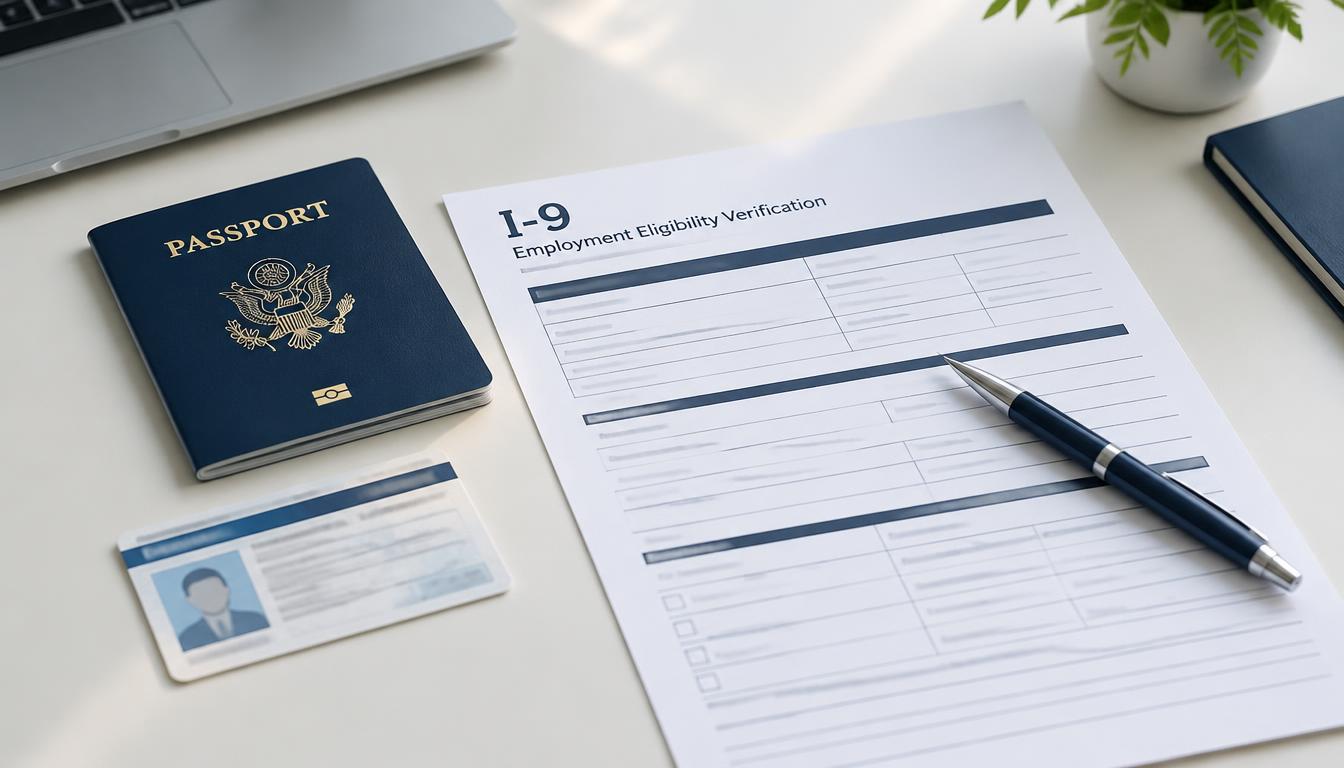
Form I-9, Employment Eligibility Verification, is a federal form from U.S. Citizenship and Immigration Services (USCIS). Every employer in the country must complete one for every person they hire, citizens and noncitizens alike. The form documents two things: the employee's identity, and their authorization to work in the United States.
The form has two main parts. Section 1 is completed by the employee, on or before their first day of work — they provide their information and attest, under penalty of perjury, to their work authorization status. Section 2 is completed by the employer (or their representative) after physically examining the employee's original documents.
What happens in Section 2?
Section 2 is the in-person part. The person completing it must physically examine the employee's original, unexpired documents — not photocopies, not photos on a phone — and record the document titles, issuing authorities, numbers, and expiration dates on the form. They then sign and date the certification, confirming the documents reasonably appear genuine and relate to the employee.
The deadline is strict: Section 2 must be completed within three business days of the employee's first day of work. A Monday start means a Thursday deadline.
Which documents are acceptable?
USCIS publishes three lists, and the employee chooses which documents to present:
- List A — documents that prove both identity and work authorization, such as a U.S. passport or permanent resident card. One List A document is enough on its own.
- List B — documents that prove identity only, such as a state driver's license or ID card.
- List C — documents that prove work authorization only, such as an unrestricted Social Security card or a birth certificate.
- If the employee doesn't have a List A document, they present one from List B and one from List C together.
The choice belongs to the employee — the person examining documents cannot demand a specific one. For a deeper look at how identification works in notarial and verification settings, see what ID you need to notarize a document in New Hampshire.
What is an authorized representative?
When a new hire works remotely or far from the employer's office, the employer can designate an authorized representative to complete Section 2 in person on their behalf. The representative can be anyone the employer chooses — a colleague, an HR partner, or a professional such as a notary public acting in a personal capacity. The employer stays responsible for the form's accuracy, so clear written instructions matter.
A note on the notary's role here: completing an I-9 as an authorized representative is not a notarization. No notary seal goes on the form, and no notarial certificate is involved. The representative simply examines the documents and signs Section 2 as the employer's designee.
Common mistakes to avoid
- Missing the three-business-day deadline for Section 2.
- Accepting photocopies or expired documents.
- Telling the employee which specific documents to bring instead of letting them choose from the lists.
- Leaving fields blank — dates, signatures, and the employer's business name and address all matter.
- Completing Section 2 by video call or from photos when an in-person examination is required.
How Valdez Notary can assist
If you're an employer with a remote hire in New Hampshire — or an employee whose out-of-state employer needs someone local — Valdez Notary can meet the employee in person, examine their original documents, and complete Section 2 as the employer's authorized representative. Mobile appointments are available across Manchester and surrounding Southern New Hampshire, at the employee's home, workplace, or another agreed location. Call (603) 854-4774 or book online, and have the employer's instructions ready.
Frequently asked questions
- What documents does an employee need for the I-9?
- The employee chooses from the federal Lists of Acceptable Documents: either one document from List A (such as a U.S. passport or permanent resident card), or one from List B (such as a driver's license) plus one from List C (such as a Social Security card or birth certificate). Documents must be original and unexpired — photocopies are not accepted.
- Can a notary complete an I-9?
- A notary public can serve as an employer's authorized representative to complete Section 2, acting in a personal capacity rather than performing a notarial act — no notary stamp is applied to the form. The employer designates the representative, who examines the documents in person and signs Section 2.
- How quickly does Section 2 have to be completed?
- Within three business days of the employee's first day of employment. For example, if the employee starts on a Monday, Section 2 must be completed by Thursday of that week.
- Who is responsible if the I-9 has errors?
- The employer remains responsible for the accuracy of the form even when an authorized representative completes Section 2. That's why employers typically give the representative clear written instructions for the appointment.
- I-9
- employment verification
- employers
- remote hires
Related articles

Need a Spanish-Speaking Notary in New Hampshire? What to Expect at a Bilingual Appointment
How a bilingual notary appointment works in New Hampshire: why direct communication in Spanish matters, what to bring, and how certified English–Spanish translation fits in.

Does a Power of Attorney Need to Be Notarized? A New Hampshire Guide
Why New Hampshire banks, hospitals, and title companies expect a notarized power of attorney, who signs, what the notary verifies, and how a mobile appointment works when signing is difficult.

Notary Near Me in Manchester, NH: What to Know Before Booking a Mobile Notary
Searching for a notary near you in Manchester? Here is how mobile notarization works, what ID you need, where we can meet, and what to ask before you book.